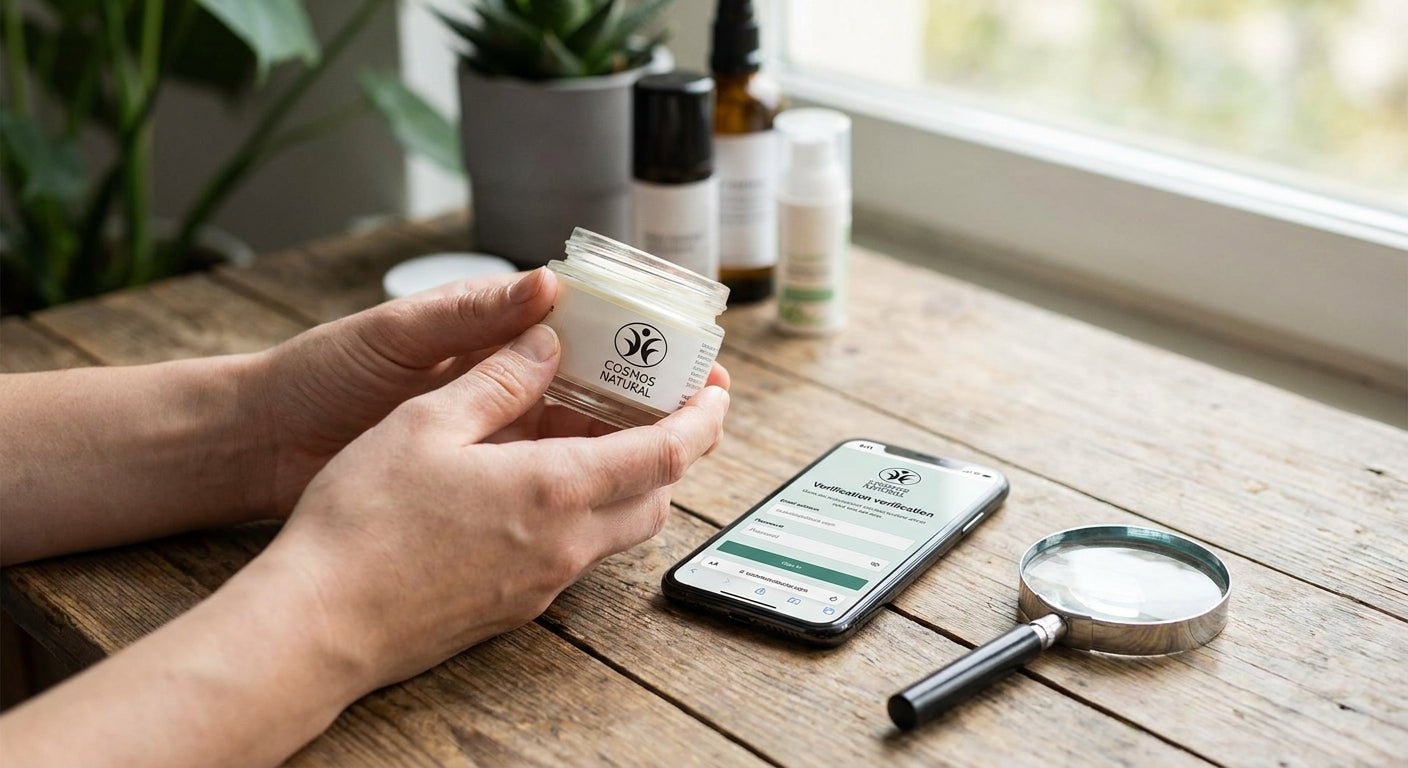
A COSMOS Natural claim is a specific, checkable fact — not a marketing word a brand gets to choose for itself. This guide walks through exactly how to confirm a certification like COSMOS Natural is real before you trust the label in front of you.
- COSMOS Natural is issued by an approved certifying body such as Ecocert, not by the brand — verify the license number, never the badge alone.
- OLIRS holds COSMOS NATURAL certification alongside Vegan, Cruelty-Free, Gluten-Free, Nut-Free, and Paraben-Free status, and each one is independently checkable.
- A certificate with no license number, no audit date, and no product-level scope is a claim you can't verify — treat it as unverified in 2026.
- COSMOS NATURAL and COSMOS ORGANIC are two different tiers; a brand writing 'organic' without holding that separate certification is overstating the claim.
Why this matters
"Natural" has no legal definition in cosmetics. Any brand can print it on a bottle with nothing behind it. COSMOS Natural is different — it's a formal standard, administered by a licensed certifying body, that audits the formula ingredient by ingredient and checks how each one was extracted, not just what it's called.
That gap between the word "natural" and the certification COSMOS Natural is exactly where most label confusion lives. A green leaf icon costs nothing to print. A license number issued by Ecocert costs the brand a real audit. OLIRS built its whole approach around that distinction: don't take the badge on faith, check the number behind it.
What you'll need
- The product's packaging or product page, with the certification logo visible
- 10-15 minutes and an internet connection
- The brand's INCI (ingredient) list, published in full
- The name of the certifying body, if the brand states one (Ecocert is the most common issuer of COSMOS Natural)
- A note-taking app or browser tab to track what you find
If a brand won't show you the INCI list, stop here. Everything past this point depends on being able to read it.
The steps
1. Find the certifying body's name, not just the logo
A COSMOS Natural badge means nothing on its own — it's the body behind it that makes the claim real. Look on the packaging, the product page, or the brand's certification page for the name of the auditor: Ecocert, Cosmebio, ICEA, BDIH, and Soil Association are the recognized COSMOS-approved certifiers in 2026. If the page only shows a logo with no name attached, that's your first red flag.
Common mistake: assuming any leaf-shaped icon is a certification. It's a design choice, not a standard.
2. Pull the license number
A real COSMOS Natural certificate comes with a license or certificate number, usually printed near the logo or listed on the brand's ingredient or certification page. This number is the actual proof — it's what you'll use to check the claim against the certifying body's own records, not the brand's word.
3. Search the certifying body's public registry
Ecocert and the other COSMOS-approved bodies maintain lookup tools for their issued certificates. Enter the license number and confirm it returns a match with the brand name attached. No match means the number is either mistyped, expired, or was never issued.
Common mistake: searching the brand name instead of the license number. Brand-name searches return marketing pages, not audit records.
4. Confirm the certificate covers the product, not just the company
This is the detail almost everyone skips. A manufacturer can hold a COSMOS Natural certification for one product line while shipping a dozen others with no certification at all. Check that the specific product you're looking at is named on the certificate, not just the parent company. The All-In-One Facial Oil and Gentle Cleansing Milk are examples of products where the certification and the sourcing story are both traceable at the product level, not just company-wide.
5. Check the audit date
COSMOS certificates are re-audited on a set cycle, not issued once and left alone. If the date on the certificate is more than a year or two old with no renewal listed, the certification may have lapsed. An expired certificate isn't current proof of anything, even if the badge is still printed on the bottle.
6. Read the INCI list against what COSMOS actually checks
COSMOS Natural audits whether ingredients keep their natural origin through processing and screens out specific banned classes: synthetic fragrance compounds, silicones, PEGs, and several preservative types. Scan the INCI list for those and flag anything that looks inconsistent with a certified-natural formula. This step won't catch everything, but it catches the obvious mismatches.
7. Separate "organic" from "natural"
COSMOS NATURAL and COSMOS ORGANIC are two separate certifications with different requirements — ORGANIC is the harder one to earn. If a brand writes "organic" on a product that's only certified COSMOS NATURAL, that's a real claim being stretched into one it hasn't earned. Watch for that swap specifically; it's the single most common label inflation in the category in 2026.
8. Decide based on what you found, not what you hoped to find
If the license number checks out, the product is named on the certificate, the audit date is current, and the INCI list matches, the claim is real. If any one of those pieces is missing, you don't have proof — you have a badge.
“If a certification badge has no license number attached to it, it's decoration, not proof.”
Troubleshooting
- The brand won't share a license number. Treat the claim as unverified and move on. A brand with a real certification has no reason to withhold the number.
- The certifying body isn't on COSMOS-standard.org's approved list. The product may carry a private "natural" standard that borrows COSMOS language without the actual audit. Not the same thing.
- You find the certificate, but it's expired. An expired certificate covered the formula at some point in the past, not necessarily the version sitting on shelves in 2026.
- The certificate covers the company, not the product. Ask the brand directly which SKUs are named on the certificate — a general company-level cert doesn't extend to every item they sell.
- The INCI list isn't published anywhere. You can't check anything past this point. No published ingredient list means no way to verify the formula-level claims at all.
- The word "organic" appears without a separate COSMOS ORGANIC certificate. That's a claim outrunning the paperwork — flag it and ask which certification actually backs the word.
Tools and resources
- The certifying body's own public certificate lookup (Ecocert's is the most commonly referenced for COSMOS Natural)
- COSMOS-standard.org's list of approved certifying bodies
- An INCI decoder tool to check what individual ingredients on the label actually are
- The brand's own certification or ingredients page — OLIRS lists COSMOS NATURAL alongside Vegan, Cruelty-Free, Gluten-Free, Nut-Free, and Paraben-Free status as separate, checkable claims rather than one bundled "natural" badge
What to do next
Once you know how to check a certification, the next skill is building a routine around products that actually hold up under that scrutiny. A no-fuss routine guide walks through ordering cleanser, serum, and moisturiser without guesswork — useful once you've filtered out the products that can't back their claims.
FAQ
What is COSMOS Natural certification?
COSMOS Natural is a cosmetics standard that audits a formula's ingredients and how each one was extracted, verified by an independent certifying body rather than declared by the brand. It's a checkable claim, not a marketing word.
Who certifies COSMOS Natural?
Approved certifying bodies including Ecocert, Cosmebio, ICEA, BDIH, and Soil Association issue COSMOS Natural certificates. A product should list which body certified it and the license number that body assigned.
Is COSMOS Natural the same as organic?
No. COSMOS ORGANIC is a separate, harder-to-earn certification within the same standard. A product certified COSMOS NATURAL cannot be marketed as 'organic' unless it also holds the ORGANIC certification.
How do I find a brand's COSMOS certification number?
Check the packaging near the certification logo or the brand's dedicated certification page. A real COSMOS Natural claim comes with a license number you can search against the certifying body's public registry.
Can a brand fake COSMOS Natural certification?
A brand can print a leaf icon with no license number behind it, which functions as a fake claim even without technically lying. The fix is checking the license number against the certifying body's registry, not trusting the icon.
Does COSMOS Natural mean the product is vegan?
Not automatically. COSMOS Natural and vegan status are separate certifications a brand earns independently, so check both if you need a formula free of animal-derived ingredients.
How often is a COSMOS Natural certificate renewed?
COSMOS certificates run on a defined audit cycle rather than being issued once permanently. Check the audit date on the certificate itself rather than assuming a badge printed on a 2026 label reflects a current audit.
Does COSMOS Natural certification cover a whole product line?
Not necessarily. A company can hold certification for specific products while other items in its catalog carry no certification at all, so check that the exact product you're looking at is named on the certificate.
One last thing
The detail almost nobody checks is whether a certificate names the specific product or just the parent company. A brand can be genuinely COSMOS Natural certified on one formula and completely uncertified on the next ten, and both will sit on the same shelf under the same logo. Check the product-level scope, every time, in 2026 and after.